
The Essential 7C’s
Diamond Fluorescence
Diamonds that are said to be fluorescent contain particles that emit a visible (usually blue) glow when exposed to UV lighting. In rare cases, high levels of fluorescence can make stones appear milky or hazy, although for the most part fluorescence does not generally impact beauty or sparkle and can even make some lower colours (I, J, K, L, etc.) appear more colourless or white. Nonetheless, fluorescent diamonds are usually cheaper and provided the effect is not readily visible may offer good value for money.
INTRODUCTION
The subject of diamond fluorescence has been hotly debated in recent years, with trade opinion divided regarding its effect on the appearance and value of diamonds.
Fluorescence occurs in some diamonds when they are exposed to the concentrated radiation of a UV lamp. Submicroscopic structures in the diamonds cause them to emit a visible light, a fluorescence, which is commonly blue in colour. Despite the fact that fluorescence is used as an identifying characteristic rather than a grading factor in most laboratory quality reports, its presence in such reports is being used with increasing frequency to determine the pricing of a diamond. In most cases, prices are lowered when a colourless or near-colourless diamond fluoresces under UV light, due to a common perception that fluorescence has a negative effect on the appearance of diamonds. However, there are many who believe that fluorescence has no adverse effect; some even contend that it enhances colour appearance.
The negative image of fluorescing diamonds can be attributed to the following theories and factors:
- Non-fluorescent diamonds are regarded as ‘purer’;
- Strongly fluorescent diamonds can emit an opaque ‘cloud’ which affects the clarity and brilliance of the diamond;
- GIA lab grading lights emit a small amount of UV radiation, therefore fluorescent diamonds might be assigned a better colour grade than they deserve.
Those who refute the notion that fluorescent diamonds are less desirable argue that:
- UV light is not present in many viewing environments, so it makes sense to grade colour in realistic lighting;
- The haziness found in highly fluorescent diamonds is extremely rare;
- In some cases, fluorescence can lift colour to the naked eye, enhancing the beauty of the diamond.
A 1997 study conducted by the GIA concluded that, in most cases, fluorescence does not impact the face up appearance of a diamond. In fact, they found that “strongly blue fluorescent diamonds were perceived to have a better colour appearance when viewed table-up” compared to non-fluorescent diamonds. (Source: A Contribution To Understanding The Effect Of Blue Fluorescence On The Appearance Of Diamonds, by Thomas M. Moses, Ilene M. Reinitz, Mary L. Johnson, John M. King, and James E. Shigley)
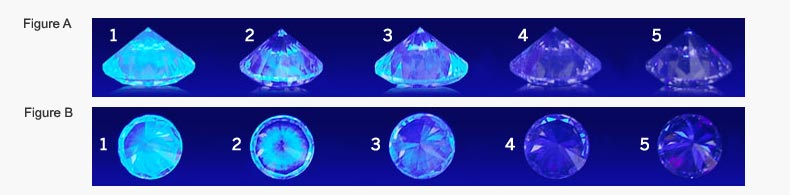
Figure A & Figure B show the varying levels of fluorescence on diamonds viewed table-down and table-up. The levels are as follows: 1. Very strong, 2. Strong, 3. Medium, 4. Faint, 5. None.